
Manuals
Manufacturer: Nissan
Nissan Motor Company was founded in Yokohama, Japan, in 1933 and became one of the world's largest automakers, forming a long-standing alliance with Renault beginning in 1999. The company released the Leaf in 2010 as one of the first mass-market electric cars and is also known for the GT-R performance car and its pioneering work with continuously variable transmissions. Nissan's reputation has been mixed in recent years, with its CVTs drawing reliability complaints and the company experiencing financial difficulties and leadership turmoil following the arrest of former chairman Carlos Ghosn in 2018.
Model: G35
The Nissan G35, sold in North America as the Infiniti G35 and in Japan as the Nissan Skyline V35, was produced from 2002 to 2007 as a single generation (V35) with a mid-cycle facelift for the 2007 model year. It served as the entry-level sports sedan and coupe in Infiniti's lineup, positioned below the Q45 flagship. Built on Nissan's FM platform shared with the 350Z, it featured rear-wheel drive and the VQ35DE V6 engine, with output rising from 260 to 306 horsepower over its run. Typical strengths included balanced handling, an available six-speed manual transmission, and strong engine response.
Year: Coupe
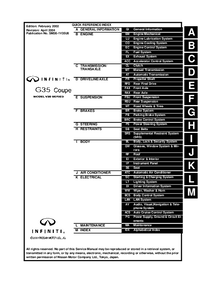
The Nissan G35 Coupe was produced from 2003 to 2007, receiving a revised front fascia and interior updates for 2005 before being discontinued and later replaced by the G37 Coupe. It was powered by the 3.5-liter VQ35DE V6 paired with either a 5-speed automatic or 6-speed manual transmission. Common service considerations include timing chain tensioner wear, oil consumption, catalytic converter failures, and automatic transmission issues at higher mileage. Suspension components, window regulators, and ignition coils are also frequent wear items on higher-mileage examples.
Code: 2003
The 2003 Nissan G35 Coupe is rear-wheel drive and powered by a 3.5-liter VQ35DE V6, paired with either a 5-speed automatic or a 6-speed manual transmission depending on trim. Typical maintenance focuses on the timing chain system, ignition coil packs, and cam and crank position sensors, with some engines known for elevated oil consumption. Regular service also includes transmission and differential fluid changes, brake component wear, and suspension bushing inspection.
-
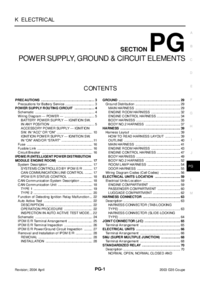 Pg pg.pdf
 -
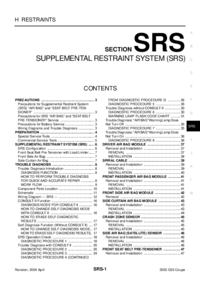 Srs srs.pdf
 -
 Fl fl.pdf
 -
 Acs acs.pdf
 -
 Lu lu.pdf
 -
 Gi gi.pdf
 -
 Pb pb.pdf
 -
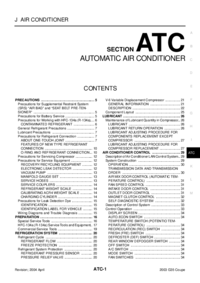 Atc atc.pdf
 -
 Ps ps.pdf
 -
 Wt wt.pdf
 -
 Ww ww.pdf
 -
 Ec ec.pdf
 -
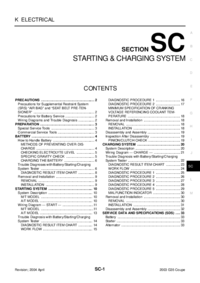 Sc sc.pdf
 -
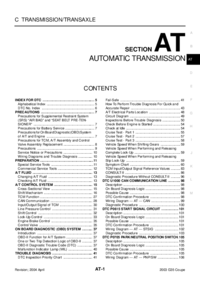 At at.pdf
 -
 Br br.pdf
 -
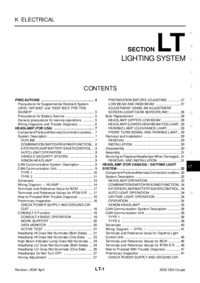 Lt lt.pdf
 -
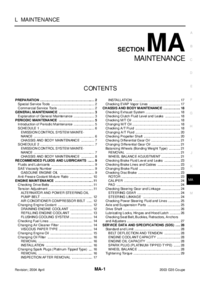 Ma ma.pdf
 -
 Rf rf.pdf
 -
 Bcs bcs.pdf
 -
 Em em.pdf
 -
 Se se.pdf
 -
 Cl cl.pdf
 -
 Acc acc.pdf
 -
 Rsu rsu.pdf
 -
 Fsu fsu.pdf
 -
 Co co.pdf
 -
 Mt mt.pdf
 -
 Gw gw.pdf
 -
 Rfd rfd.pdf
 -
 Idx idx.pdf
 -
 Ei ei.pdf
 -
 Di di.pdf
 -
 Brc brc.pdf
 -
 Lan lan.pdf
 -
 Rax rax.pdf
 -
 Bl bl.pdf
 -
 Sb sb.pdf
 -
 Ex ex.pdf
 -
 Fax fax.pdf
 -
 Av av.pdf
 -
 Fwd fwd.pdf
 -
 Pr pr.pdf
 -
 Ip ip.pdf