
Manuals
Manufacturer: Nissan
Nissan Motor Company was founded in Yokohama, Japan, in 1933 and became one of the world's largest automakers, forming a long-standing alliance with Renault beginning in 1999. The company released the Leaf in 2010 as one of the first mass-market electric cars and is also known for the GT-R performance car and its pioneering work with continuously variable transmissions. Nissan's reputation has been mixed in recent years, with its CVTs drawing reliability complaints and the company experiencing financial difficulties and leadership turmoil following the arrest of former chairman Carlos Ghosn in 2018.
Model: versa
The Nissan Versa serves as the brand's entry-level subcompact sedan, positioned below the Sentra in the lineup. It debuted for the 2007 model year as a replacement for the Sentra in the subcompact segment, with the first generation offered as both a sedan and hatchback. A second generation arrived in 2012, and a third generation launched for 2020 on the Renault-Nissan CMF-B platform, with the hatchback body style discontinued. The model is typically noted for its low starting price, fuel efficiency, and, in later years, standard driver-assistance features.
Year: 2007
The 2007 Nissan Versa debuted as an all-new compact sedan, powered by a 1.8-liter four-cylinder engine paired with a six-speed manual, four-speed automatic, or continuously variable transmission. As the first model year of the nameplate in the United States, it arrived with a simplified trim structure and few mid-year changes. Common service considerations include CVT fluid changes on models so equipped, regular oil and filter service, brake inspections, and attention to aging suspension components such as struts and bushings. The 1.8-liter engine uses a timing chain rather than a belt, so timing belt replacement is not part of its maintenance schedule.
Code: hatch
The 2007 Nissan Versa hatchback uses a 1.8-liter HR16DE four-cylinder engine with front-wheel drive, available with a 6-speed manual, 4-speed automatic, or CVT transmission. The engine employs a timing chain rather than a belt, so timing component service is not part of the standard maintenance schedule. CVT-equipped models benefit from periodic transmission fluid changes to support long-term reliability. Routine upkeep typically focuses on oil changes, spark plugs, brake components, and suspension wear items.
-
 FSU FSU.pdf
 -
 FL FL.pdf
 -
 RF RF.pdf
 -
 LU LU.pdf
 -
 BR BR.pdf
 -
 WW WW.pdf
 -
 DI DI.pdf
 -
 LAN LAN.pdf
 -
 GI GI.pdf
 -
 GW GW.pdf
 -
 IP IP.pdf
 -
 MT MT.pdf
 -
 AT AT.pdf
 -
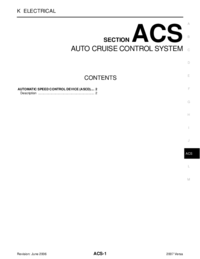 ACS ACS.pdf
 -
 Service Manual service_manual.zip
 -
 RSU RSU.pdf
 -
 CO CO.pdf
 -
 EC EC.pdf
 -
 CL CL.pdf
 -
 SB SB.pdf
 -
 RAX RAX.pdf
 -
 ACC ACC.pdf
 -
 FAX FAX.pdf
 -
 EM EM.pdf
 -
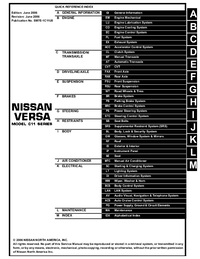 Fwd fwd.pdf
 -
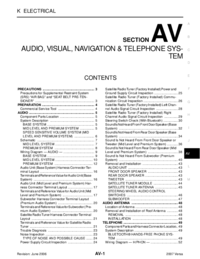 AV AV.pdf
 -
 MTC MTC.pdf
 -
 SRS SRS.pdf
 -
 BRC BRC.pdf
 -
 SC SC.pdf
 -
 WT WT.pdf
 -
 PB PB.pdf
 -
 CVT CVT.pdf
 -
 IDX IDX.pdf
 -
 MA MA.pdf
 -
 BL BL.pdf
 -
 LT LT.pdf
 -
 EX EX.pdf
 -
 BCS BCS.pdf
 -
 SE SE.pdf
 -
 PS PS.pdf
 -
 EI EI.pdf
 -
 STC STC.pdf
 -
 PG PG.pdf